


Today, we are going to discuss one of a dog’s simplest but most important needs: having the opportunity to go to the toilet at the right time.
Urination and bowel movements are basic physiological needs. Unlike many other pets, dogs often depend entirely on their owners to open the door, pick up the leash and take them outside.
This means that responsibility for the dog’s comfort, health and daily toilet routine lies with us.
How often does a dog need a toilet break?
There is no single schedule that is suitable for every dog. The required frequency depends on several factors:
- the dog’s age;
- overall health;
- activity level;
- water consumption;
- diet;
- medication;
- environmental temperature;
- individual physical needs.
A healthy adult dog will normally urinate several times during the day. For many adult dogs, having an opportunity to go outside approximately every four to five hours during the daytime can be a comfortable guideline, but it should not be treated as a strict rule.
Puppies, senior dogs and dogs with urinary or other medical conditions may need much more frequent toilet breaks.
How long can a dog hold its urine?
A dog being physically capable of holding its urine for a long time does not necessarily mean that it feels comfortable doing so.
Some healthy adult dogs can wait for relatively long periods, particularly at night. However, a dog’s daily routine should not be deliberately designed around making it wait until the last possible moment.
A dog’s size may influence its individual needs, but a large dog should not be expected to wait for excessive periods simply because it appears capable of doing so.
Every dog should be given an opportunity to relieve itself when its body needs to.
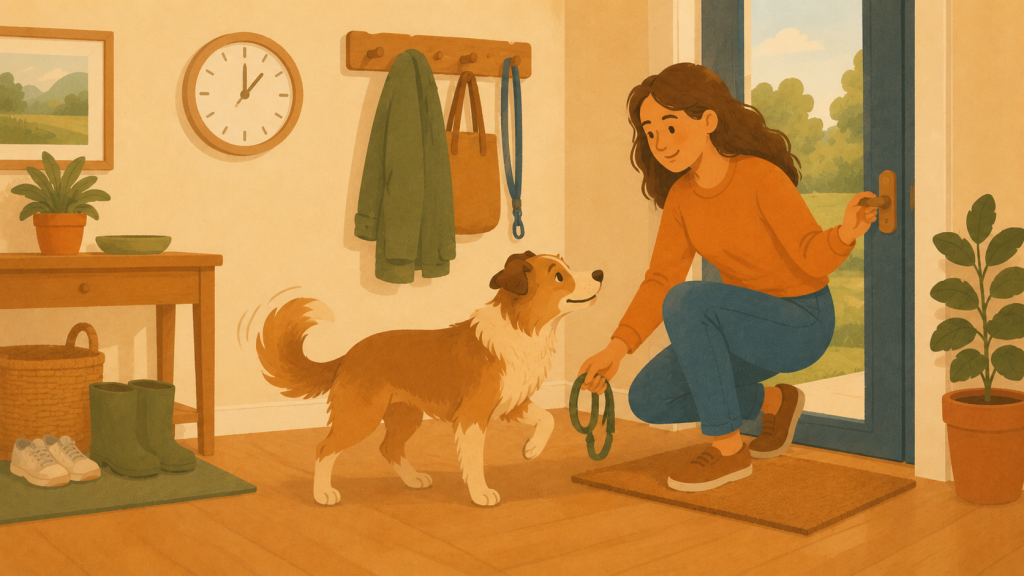
Is taking a dog outside twice a day enough?
In my work, I regularly meet dogs that are taken outside only once in the morning and once in the evening.
For some dogs, this schedule is not sufficient. There may be 10 or even 12 hours between the morning and evening walks. A dog may learn to wait that long, but this does not prove that it feels comfortable.
Long intervals can be particularly difficult for:
- puppies;
- senior dogs;
- small or sensitive dogs;
- dogs that drink large amounts of water;
- dogs recovering from surgery;
- dogs with kidney, bladder or endocrine conditions.
A short toilet break is still important
If you do not have time for a long walk, every trip outside does not need to last an hour.
You can take your dog outside for a few minutes, give it enough time to relieve itself calmly and then return home. A short toilet break does not replace a proper walk, physical activity or opportunities to explore, but it meets an important physiological need.
A full walk and a brief toilet break serve different purposes. Dogs need both.
How can infrequent toilet breaks affect a dog?
Regularly having to hold urine for long periods can cause physical discomfort and additional tension.
The dog may become restless, struggle to relax, wait near the front door, whine or repeatedly ask to go outside. Physical discomfort may also influence stress levels, concentration and behaviour.
If a dog has an accident indoors, it should not be punished. First, consider whether its toilet schedule meets its needs and whether there could be an underlying medical problem.
When should you contact a veterinarian?
A change in toilet habits is not always a training problem. It can be a sign of a urinary, kidney or endocrine condition.
Contact a veterinarian if your dog:
- suddenly starts urinating much more often;
- begins drinking much more water;
- repeatedly attempts to urinate but passes only small amounts;
- strains or appears to be in pain;
- cries or whines while urinating;
- has blood in its urine;
- begins having accidents despite previously being house-trained;
- is unable to pass urine.
If your dog is attempting to urinate but cannot pass any urine, contact an emergency veterinary clinic immediately.
A comfortable routine supports a relaxed dog
Organise your day so that your dog is not constantly forced to wait from the morning walk until the evening.
Observe its behaviour and consider its age, health and individual needs. When necessary, add a brief daytime toilet break or ask a family member, neighbour or dog walker for help.
For owners looking for a dog trainer, personal dog trainer or dog training in Unterschleißheim and Munich, it is important to remember that calm behaviour does not begin with commands alone. It also begins with meeting the dog’s basic needs.
Going to the toilet at the right time is not a privilege or a reward for good behaviour. It is a basic need of every dog.
Leave a Reply