

A slow feeder for dogs, licking mat or waiting exercise before a meal can make eating take longer. However, these tools do not always address the reason why a dog swallows its food within seconds.
Fast eating is not necessarily caused by poor training or a lack of self-control. In some dogs, it may be connected to anxiety, previous competition for food, life in a shelter, resource scarcity or a diet that does not match the dog’s individual needs.
Why does my dog eat so fast?
Possible reasons include:
- competition for food during puppyhood;
- living with animals that could take the dog’s food;
- previous experience as a stray or shelter dog;
- an irregular or unpredictable feeding history;
- long intervals between meals;
- a diet that does not provide enough energy for the individual dog;
- a high activity level;
- food-related anxiety or resource guarding;
- certain medical conditions or medications.
It is important not to assume that every fast-eating dog has been starved or traumatised. However, when a dog behaves as though its meal could disappear at any moment, its emotional state should be taken into account.
Why does a slow feeder not always solve fast eating?
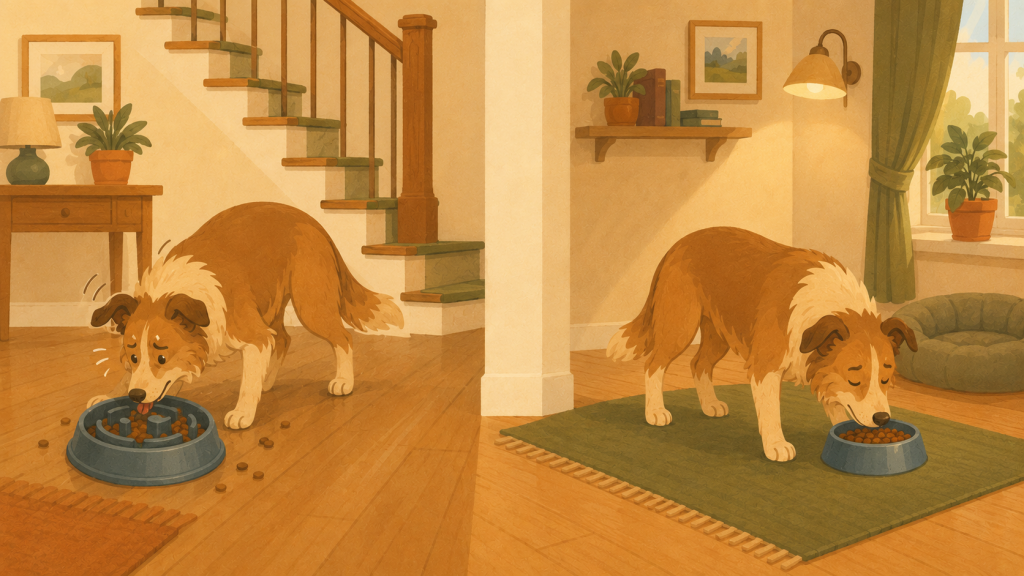
A slow feeder physically restricts access to food. The dog has to remove pieces from grooves, ridges or narrow sections, which increases the time required to finish the meal.
For a relaxed dog, this can be a useful way to slow eating and provide environmental enrichment.
For a dog that is already anxious about food, making access more difficult may increase frustration. The dog may not feel calmer; it may simply have more difficulty reaching something it considers extremely valuable.
Watch how your dog responds. Possible signs that the feeding method is creating discomfort include:
- rapid and frantic movements;
- a tense or stiff body;
- trying to overturn or chew the bowl;
- whining or barking;
- repeatedly looking around while eating;
- growling when people or animals approach;
- increased excitement before each meal.
Should a dog be made to wait before eating?
Calm waiting can be a useful skill when it is taught gradually and without pressure. However, making a hungry or highly aroused dog wait for a prolonged period does not address the underlying reason for fast eating.
When food is already associated with tension, adding more requirements can make mealtimes feel even less predictable.
Every meal does not need to become a difficult obedience test. Sometimes the first thing a dog needs to learn is that food arrives regularly, belongs to the dog and will not suddenly be taken away.
How can you create a calmer feeding routine?
- place the bowl in a quiet area;
- feed animals separately if there is competition;
- do not stand over the dog while it eats;
- avoid touching or petting the dog during the meal;
- do not remove the bowl to test obedience;
- follow a predictable feeding schedule;
- provide constant access to fresh water;
- allow the dog to finish eating without interruption.
In a multi-dog household, each dog should ideally have its own safe feeding space. This can reduce competition and the perceived need to swallow food as quickly as possible.
Can you divide a dog’s daily food allowance?
If a dog receives all its food in one large meal and finishes it within seconds, consider discussing two to four smaller meals with your veterinarian.
This does not mean increasing the total amount of food. The same measured daily allowance is divided into smaller, more predictable meals.
The correct amount depends on the dog’s age, weight, health, activity level and body condition. A dog that appears constantly hungry should be assessed by a veterinarian or veterinary nutrition professional.
When is professional help needed?
Contact a veterinarian if fast eating begins suddenly or is accompanied by:
- constant or extreme hunger;
- unexpected weight loss or gain;
- increased thirst;
- vomiting or frequent regurgitation;
- diarrhoea;
- abdominal pain or swelling;
- other changes in health or behaviour.
If the dog freezes, growls, snaps or guards the food bowl, consult a qualified dog behaviour professional. Do not punish the behaviour or attempt to take the food by force.
A slow feeder is a tool, not a universal solution
A slow feeder is not inherently bad. It can help many dogs eat more slowly and can be a useful form of enrichment.
The dog’s response should determine whether the tool is appropriate. If the dog remains relaxed, eats without frantic behaviour and does not struggle excessively to reach the food, the slow feeder may be suitable.
If it increases anxiety or frustration, the priority should be creating safety, predictability and confidence that an appropriate amount of food will be available.
For owners looking for a dog trainer, personal dog trainer or dog training in Unterschleißheim and Munich, food-related anxiety should be approached by considering both the behaviour and its underlying cause.
Sometimes the best first step is not to make food more difficult to access, but to let the dog eat peacefully in a safe place.
Leave a Reply